
Advanced Cooling Methods
Learn about liquid flow-through and air flow-through cooling options for rugged 3U VPX and 6U VPX products from X-ES.
High-Powered Products Demand
Innovative Thermal Management
As processors and other components in embedded systems become more powerful over time, the heat they generate is increasingly challenging for traditional methods to dissipate.
For this reason, X-ES offers liquid flow-through (LFT) and air flow-through (AFT) cooling as options on high-power-density VPX products.
These advanced cooling methods provide a more effective and efficient solution for electronic thermal management, making it possible to support a whole new level of power and capability at the module level.
View VPX Products

Understanding the Problem
Power and heat go hand in hand, and the latest generations of processors output considerably more heat than their predecessors. To prevent electronic components from burning out or otherwise failing, manufacturers may design components to throttle performance or even shut down entirely in response to catastrophic overheating.
However, in the kind of mission-critical applications in which X-ES products are deployed, even a momentary reduction in performance and capability can have serious consequences.
Rugged Challenges
In conventional everyday electronics systems, modified air- and conduction-cooling methods might be able to keep up with increased heat, but rugged systems have additional considerations:
- Cost and weight restrictions that make additional fans, heat sinks, and other modifications unfeasible
- Insufficient air for effective circulation in high-altitude, low-pressure conditions
- Dust, humidity, smoke, and other particulates in the air that can physically damage components
LFT/AFT Solutions from X-ES
Liquid Flow-Through (LFT)
Cooling Capability: Over 200W
Form Factors Supported: 6U VPX
Defined By: VITA 48.4
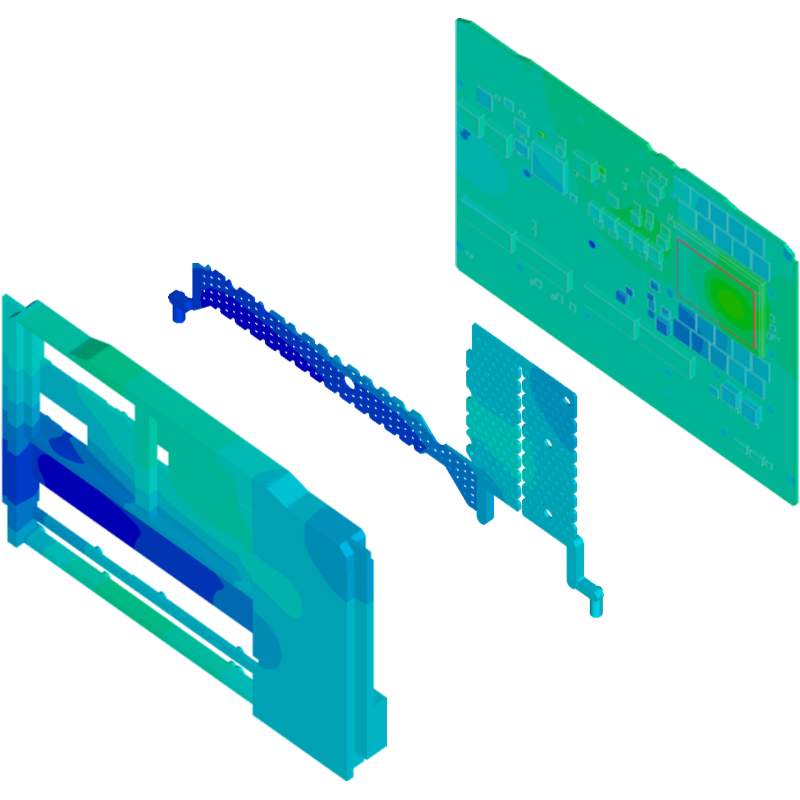
LFT cooling pumps an externally supplied coolant through quick disconnect (QD) connectors on the heat frame of individual modules. This fluid is then routed near and around the heat-generating electronics via a winding network of channels.
The LFT method offers cooling capabilities well in excess of 200 W, and results are variable depending on the fluid used. LFT adds some weight to designs, but it ultimately uses less power than fans and is considerably more efficient.
Mature Use
X-ES has proven expertise implementing LFT cooling. From simulating the initial concept, to developing the manufacturing infrastructure required to test LFT units, to manufacturing and delivering the end solution, X-ES has done it all.
Potentially all of X-ES’ 6U VPX designs could be made to support LFT cooling. VITA 48.4 does not define a 3U VPX LFT option.
Air Flow-Through (AFT)
Cooling Capability: Up to 200W
Form Factors Supported: 3U VPX, 6U VPX
Defined By: VITA 48.8*
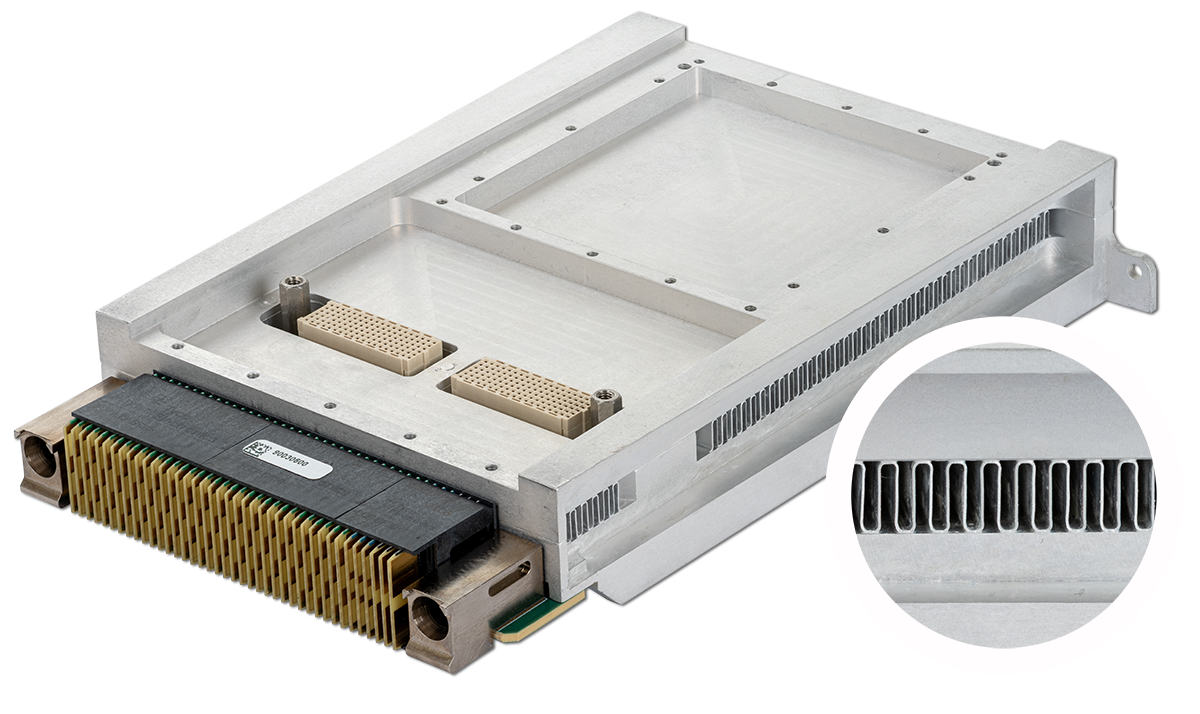
AFT cooling forces air through a heat exchanger, bringing the cooling air significantly closer to the heat-generating electronics than traditional conduction cooling.
The air used in AFT cooling is confined in a closed duct instead of directly circulating on the board. As a result, moisture, particulates, and other outside elements that might be present in the surrounding environment are prevented from potentially damaging sensitive components.
Deployable-Ready
AFT cooling offers simple, low-weight, high-reliability heat management without requiring outside fluids. Multiple slot plates are supported, and the VITA 48.8 specification also allows for mezzanine cards to be hosted on the carrier.
Our simulations and verification testing indicate a marked reduction of heat when the AFT methodology is in use. Potentially all of X-ES’ 3U VPX and 6U VPX designs could be made to support AFT cooling.
* Alternative VITA 48 specifications for AFT exist, including VITA 48.5 and VITA 48.9. If required by your designs, please contact X-ES.
We'll Help You Find the Right Solution for Your Program's Needs
Reach out to X-ES to start a conversation about technical considerations, coolant options, and any other questions you might have about converting 3U VPX and 6U VPX designs to adopt these advanced cooling methods.
Contact Us